Wednesday, January 20, 2016

Top 6 Mistakes Marketers Make on YouTube Influencer Campaigns

According to recent studies, up to 75% of marketers are now investing in influencer marketing and 60% of brands will increase the amount they spend on it in 2016. Moreover, the latest research shows that YouTube has the best ROI above any other social media platform.

Couple that with the fact that YouTube is the second largest search engine and has a monthly user base of more than 1 billion people, it’s no surprise that YouTube sponsorships are one of today’s top-ranked customer acquisition tools.

YouTube marketing offers big rewards, but the path to success in this uncharted territory can be bumpy. In this article I will share the top 6 mistakes marketers often make, as well as strategies for avoiding them.

Mistake #1 – Action Without Strategy

One common mistake marketers make when launching YouTube influencer campaigns is to only have vague goals and objectives in mind. Often marketers’ only goal is to reach a certain amount of views and interactions (likes, comments, shares) per video or across several channels.

Managers start allocating marketing budgets and choosing talent before clearly defining which metrics should be used to measure a campaign’s success. Is it a sales play campaign measured by lead to customer conversion rates, revenues and acquired customers’ lifetime value? Is it a brand awareness campaign measured by increase in brand recognition, referral and direct traffic or lift in brand conversation? Is it brand channel growth activation campaign measured by an increase in new visitors and subscribers? Or maybe the objective is a combination of any of the above.

An ROI positive YouTube influencer campaign requires a well thought out strategy. Along with numeric campaign goals, marketers should define KPIs – key metrics indicating whether a campaign’s performance can achieve these goals. This will allow for better decisions and strategies to meet the ultimate objectives.

Here is an example of a sales play campaign goals and KPIs:

Goal: 3000 app downloads, CPA ≤ $10

  • KPI 1: 3% website leads/video views conversion rate
  • KPI 2: 20% app downloads/website visits conversion rate
  • KPI 3: 500,000 video views
  • KPI 4: Cost per view ≤ $0.06

In this example the maximum campaign spend has been defined at $30,000 (500,000*$0.06). We know how many views and at which conversion rates we have to hit in order for the campaign to be successful.

Mistake #2 – The Blind Date

Discovery is a crucial stage and will define a campaign’s success. During the stage, marketers tend to fall into a common trap: choosing talent based solely on the channel’s number of subscribers and latest video views.

However, YouTube hosts a much larger amount of data on video watching behavior and habits. The rise of Big Data analytics provides online tools to help marketers dig deep to find the highest-quality talent for their brand. There are several key data-driven aspects marketers should analyze when choosing talent: Relevance, Reach, Engagement, Influence and Consistency.

Relevance identifies whether a channel’s audience will be authentically interested in your product or service and is determined by keywords and audience overlap.

Reach looks at the average number of views per video and is calculated as the average number of views during a set period of time.

Engagement measures how actively the audience interacts with a channel’s content and is usually computed using total views and interactions.

Influence indicates whether a channel stimulates action and audience growth and is calculated based on how content is shared outside the channel and if viewers turn into subscribers.

Consistency analyzes how often the channel is delivering meaningful content and is measured by averaging various channel performance metrics from video to video.

Failure to analyze any of these crucial parameters may result in a poorly targeted audience, low conversion rates and washed budgets.

Example:

The AngryJoeShow gaming channel has significantly less reach than TobyGames (2.3 million versus 7 million, respectively), but more engagement — 300K – 400K views and 7K likes on average per video, versus 30K – 40K views and 1K likes for TobyGames. We can also see a striking difference in daily subscriptions growth between the two channels:

angryjoeshow-tobygames-subscribers-graph

Without digging deeper into the data, we can already see that although TobyGames has a better overall reach, AngryJoeShow performs better on the engagement and consistency scores, which determine true audience response.

Mistake #3 – Shiny Object Syndrome

Each industry has its most popular YouTube celebrities with millions of subscribers, which may seem like the fastest and easiest solution for a brand, but they only represent 1 – 5% of all influencers.

With hundreds of new channels popping up every day, marketers tend to play it safe: activate the largest channels to secure the best results, ignoring smaller channels. This strategy may lead to disappointment, providing only mediocre outcomes. Here’s why:

Lack of targeting. If a channel has a large scattered audience, it is difficult to predict what portion of subscribers would actually be interested in the particular topic or brand. As a result, subscribers can see videos irrelevant to their interests, which hurts both the influencer (jeopardizing a follower’s trust) and the brand (triggering negative sentiment). On the contrary, small and mid-sized dedicated channels attract a homogenous audience of highly engaged followers.

Lack of authentic admiration. There is a lot going on for the most popular influencers. They cover a variety of topics, experiment with different video ideas, spend a good chunk of time on marketing and let’s be honest – often treat brand partnerships as just another business. As a result, brands do not get any special interest or authentic excitement about their product or service. At the same time smaller, niche channels are sincerely interested in the particular topic and product, which leads to higher quality endorsements.

Marketers should explore the small and mid-sized niche channels, which can become the most loyal and dedicated brand ambassadors and open doors to a highly targeted and authentically engaged audience. Another advantage is that for the same amount of marketing dollars (or less), brands can reach a greater variety of audiences and produce multiple pieces of content.

Example:

Rooster Teeth, a very popular gaming channel with more than 8M subscribers covered a popular, but rather niche video game (World of Tanks) to its widespread audience of gamers gaining 350K views. Compare it to the video produced by SideStrafe, a smaller channel with 190K subscribers, published several months later and resulting in 1.5M views and much higher engagement. SideStrafe is highly focused on the topic of military and combat games and as such attracts higher quality traffic. SideStrafe’s video content is also more effective and engaging, as he understands the game very well.

world-of-tanks-youtube

rooster-teeth-world-of-tanks-youtube

Mistake #4 – Fear of Losing Control

Marketers still fall into the trap of treating influencers as actors and editorial content as video ads. Brands underestimate how keen their users are, how fragile their trust is and how shortsighted it is to fake authenticity.

Research and case studies prove that the more authentic the content is the better users react to it, which leads to higher reach, better engagement and ultimately stronger campaign results.

Think of the Proactive case study. The company tried to mirror user generated video testimonials and hired actors to produce similar endorsements. They saw 10-20 fewer video views in comparison to the testimonials created by real users. Proactive learned its lesson and today is tapping into YouTube influencers, providing talent with creative freedom, which is essential for campaign success:
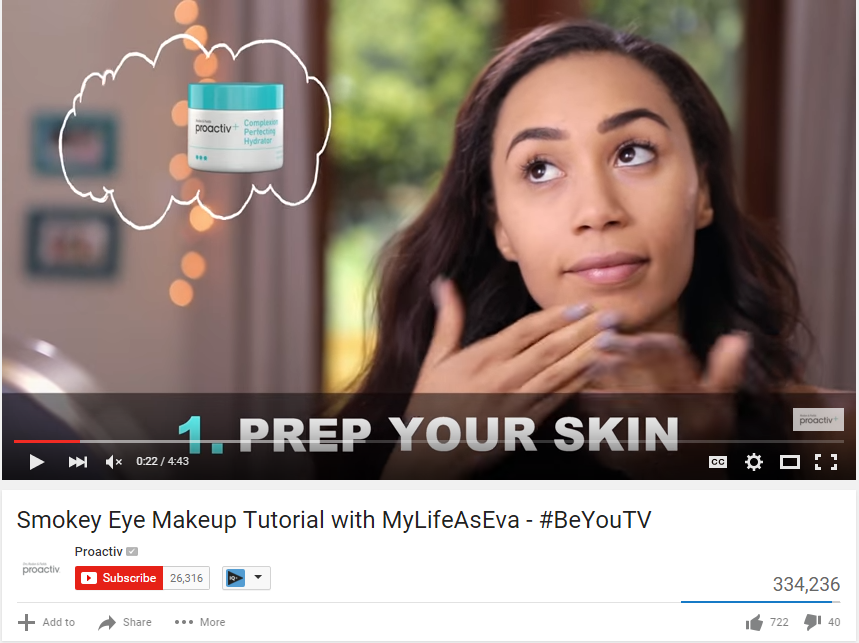
proactive-youtube

In addition to the lower reach, “over-controlled” campaigns may result into a wall of negative sentiment from the community. Once users sense content irrelevance, disingenuous feedback or any other signs of inauthenticity, they will let you and everyone else know. In the realm of YouTube, these comments hurt both the talent and brand.

youtube-comment-inauthentic

Let the talent run the show. They do it for living and know how to organically mention your product or brand, so the campaign gets a response.

Mistake #5 – Betting on an Agency

With the rise of YouTube influencers there has also been a rise of agencies to help brands with campaigns. The promise is that marketers can fully outsource the efforts and simply reap the rewards.

But there are pitfalls hidden in this approach:

Limited access. An agency only has access to talent in its network, and those channels may not always be the best fit for the brand’s needs. Marketers should assess each channel’s value and not limit their reach to only one “ideal” partner.

Lack of connection. Marketers often underestimate the level of personal connection required between brand and influencer. Influencers seek strong relationships with a brand, so that they can truly understand its values and speak on its behalf. It is impossible to achieve that level of connection via a third party, so marketers should be involved and engaged as much as possible.

Lack of niche understanding. The majority of agencies cater to brands within multiple industries and don’t fully understand the nuances of particular spaces. This is where a brand manager should step in and make sure that both talent and video content choices take into consideration industry specific aspects.

Working with agencies, managers need to carefully evaluate the emerging costs compared to the delivered value. What would be the overhead associated with launching campaign in-house and how does it compare to agency fees? What are the key competencies and resources your team is missing and are they provided for by the partner? These are key questions to ask before hiring an agency.

Mistake #6 – No Bang for Your Buck

One of the biggest challenges for marketers in YouTube influencer marketing is a lack of transparency and standardization in pricing models. They end up getting unreasonably high quotes and overspend, not realizing the room for negotiation in this developing market. There is no transparent, consistent pricing model in the world of YouTube influencer sponsorships for several reasons:

Different payment models. Different channels and agencies work on different payment models (pay per view, pay per action and pay per activation). Many agencies/talents work solely on pay per activation model and often do not tie their fees to guaranteed campaign results.

A new marketplace. YouTube influencer marketing is still in its infancy, and with a lack of benchmarks, the market hasn’t determined average rates. Currently influencers and agencies charge anywhere between $0.02 and $.20 per view, so there is a lot of room for negotiation.

Secretive transactions. Agencies rarely share their pricing structure, which leads to partners offering different fees for the same talent or campaign.

Marketers need to compare prices across the space and negotiate aggressively to get the best deal, which will secure a ROI positive campaign.

Try reaching out to the same talent via different channels: directly, through matchmaking platforms like Famebit or Grapevine, or via Multi-Channel Networks like Fullscreen or Maker Studios and learn the difference. Sometimes you will get a better deal with an agency due to their negotiated rates and sometimes you are better off with a direct connection without third party cuts.

Example: In my practice one agency quoted the same campaign at 3.6x higher than its competitor (90K vs. 25K).

Conclusion

The rise of YouTube influencers has created a new lucrative, scalable communication channel for brands, but only if approached in the right manner. Knowing the common pitfalls of YouTube influencer marketing can help brands maximize the return on investment and secure long-term rewards.

About the Author: As a thought leader in influencer marketing, Polina Haryacha has built and grown influencer programs with talents ranging from 50K to 10M subscribers, resulting in more than 50M views. Polina’s expertise in YouTube influencer campaigns has been featured in key industry publications such as TechCrunch and [a]listdaily. She has also created a course to empower other marketers, featuring her experience with talent discovery, content creation and campaign optimization. Connect with her on LinkedIn or Twitter.

The 6 Ways Your Content Marketing Might Be Broken (And How to Fix That)

content

I understand your frustration.

I see it every day.

I'm talking about marketers, or aspiring marketers, who put a lot of effort into their content marketing but just don’t get the results they need.

The truth is that effort does not equal results.

Working hard doing the wrong things won’t produce any significant results.

And that’s what most marketers do. They have a broken content marketing system.

While a lot of the pieces are right, they’re making a few big mistakes that are making their efforts fruitless.

I realize that it can be disheartening to hear that, but let me assure you that you are not alone.

According to a recent survey, only 30% of marketers rate their use of content marketing effective.

image07

Very few (6%) say that their content marketing is “very effective.”

Everyone seems to realize the potential of content marketing, but very few are getting the most out of it.

So, instead of showing you a new tactic today, I’m going to show you 6 symptoms of a broken content marketing plan.

If you recognize a symptom, that’s actually a good thing because I’m also going to show you how to fix these flaws and get back on track to success.

I realize that no one likes making mistakes, but try to keep an open mind and honestly evaluate whether you have any of the problems I am about to describe in detail here.

There’s no shame, everyone (especially me) has made many of these mistakes at one time or another. Every marketer needs to find their own path to success. 

1. You’re not getting as many backlinks as you’d like (i.e., stagnant search engine traffic)

If you know me at all, you know that I love organic search engine traffic.

It’s very consistent and typically grows over time if you’re doing content marketing right.

You can see what I mean in the 100k case study.

As you might know, search engine rankings and traffic are tied to backlinks, and that isn’t going to change any time soon.

The more high quality backlinks you have pointing to your content, the more traffic you will get.

I’ve written about how to get these backlinks and how to optimize your content for search engines many times in the past:

In this post, however, I want to focus on determining whether something is wrong with your content marketing.

If all is well, your organic search traffic should increase fairly steadily. Otherwise, we have a problem.

Symptom: Organic search traffic has plateaued or is slowly declining.

Step #1 – Check the numbers: Just as doctors turn to machines to provide them with data about their patients' health, marketers have analytics to turn to.

Start by going to Google Analytics.

Using the left sidebar, navigate to “Acquisition > All Traffic > Channels,” and then select the “Organic Search” grouping.

image01

The important part is to look over a long enough time period.

I’ve often had a span of 1-3 months during which traffic remained relatively constant, but if you have a plateau for longer than that, there’s probably an issue (with the exception of a highly seasonal niche):

Here’s an example that shows that there is something wrong:

image04

There was a really nice increase of search traffic over a few months, but since then, it has either stayed the same or declined.

That indicates that there is something really wrong with this site's content marketing.

Step #2 – Find the cure: This is a bit tougher but doable with a little bit of effort.

I’m going to assume that you know how to detect a Google penalty and that you’ve already done some basic technical SEO (like having a decent page speed).

Aside from those potential issues, the most common problem by far is not getting enough backlinks to new content.

Let me clarify – high quality backlinks. A link on a forum isn’t going to do much for your search rankings (although it won’t hurt either).

To confirm this, you need to use a link database tool. Ahrefs and Majestic are the best options.

First, input your domain into either tool:

image03

Once the page loads, you'll see a graph of the growth of all the links to your site.

Hopefully, it will look something like this:

image12

As long as your backlink count (and total referring domains) are both steadily increasing, you’re doing something right, and search traffic will almost always go up.

But what if you see a downward trend or a plateau?

image02

That tells you that your site as a whole isn’t attracting any new backlinks.

Uh oh.

That needs fixing.

It’s a clear sign that your content promotion isn’t up to par.

You should be spending at least as much time promoting your content as you do creating it. If your blog is relatively new, you should spend even more time.

Aim to get at least 20 high quality links from your promotion efforts. This takes a lot of time and persistence. You might have to send out 500+ emails per article. Do it.

You won’t see the results immediately, but after a few months, your search traffic will increase and keep rising if you keep up the work.

If you’re not really sure how to promote your content, I’ve got you covered. Read through these guides I’ve written in the past:

2. Your current audience is not finding your content useful

Think about the basic principles of content marketing.

Your content needs to have value in order to accomplish anything. If your audience isn’t finding your content useful, they’re not going to continue to read it.

This is something you want to catch as quickly as possible, or it can become tremendously hard to reverse.

Here’s what happens with most somewhat loyal readers:

  • they generally like your content, maybe even love it
  • but then they read a post that isn’t very useful. That post alone won’t deter them from coming back.
  • if they come across more posts that aren’t useful within a short time period, they will not come back.

Take a second to understand that sequence.

It’s easy to produce a less than stellar post and let it slip by because your numbers won’t take a hit. In the short term, most of your readers will still be loyal to you.

But if you let 2, 3, or 4 posts that aren’t very valuable slip by, you’ll start seeing your readership decline exponentially.

It happens all the time to even popular sites. They lose a large percentage of longtime loyal readers in just a few months because they start to cut corners.

You can’t afford to do this…ever.

Diagnosing ‘weak’ content: In order to evaluate how your audience perceives your content, you need a few different metrics to get a full picture.

There are a few different symptoms that you’ll need to keep an eye out for.

Symptom #1: Your email open rate goes down…down…and down

I suggest keeping a close eye on your email subscribers at all times. These are typically your most loyal readers, which means they provide reliable, accurate information.

Here, you need to examine your email open rate. All major email marketing service providers offer some sort of report in your account that should show you your overall email open rates over time.

Something like this:

image00

If it’s staying steady or even going up, great. You’re doing something right.

But if it’s steadily going down, that’s a sign that people are losing interest in your content. If it’s only a slight downward trend, you may be doing okay, but you’ll want to keep an eye on it.

The reason why this is a good metric to look at is because these loyal readers will open most of your emails if they expect there is valuable content in them (why wouldn’t they if your content will improve their lives?)

If your numbers are dropping, it means that more and more of your readers aren’t expecting to find useful content in your emails.

Symptom #2: The number of “actionable comments” goes down dramatically

Truth be told, I don’t really worry about the sheer number of comments I get on posts.

Sometimes I get 20 comments; other times I get 300. A lot of that depends on whether what I am writing about is interesting to all or only certain parts of my audience.

What I do care about is how many actionable comments I get.

For me, an “actionable comment” is a comment that demonstrates that the reader not only liked the content but actually took action to apply it.

image06

Makes sense, doesn’t it? If you want to see whether your readers find your content useful, see if they actually use it.

Cranking up the value and winning back your readers: The reason behind either (or both) of these symptoms is usually the same.

Some time in the recent past you started publishing content that wasn’t up to the standard you set before.

It’s really easy to do, and there are many things that can cause it:

  • distractions in your personal life
  • falling into a content creation “grind”—feeling burnt out
  • getting overwhelmed by other parts of your work or business

First of all, know that it’s okay. Everyone (including myself) has dips in the quality of their content once in awhile.

But the best marketers spot it really quickly and fix it.

The solution is actually quite simple: start putting more effort into creating more valuable content.

If you can’t do that for some reason, it might be time to at least temporarily hire a writer or editor to help you.

If you’re just feeling a bit lost with your content creation, it may be time to learn some new ways to add value to your content. Here are a few posts I’ve written that will help you inject some new life into your work:

3. Your traffic is barely growing

I think every content marketer has experienced it near the beginning of their career.

They create content on a regular basis, but the traffic never amounts to anything more than a few hundred views a month.

But there are many possible reasons for that, including publishing boring content in the first place.

I’m going to assume that you know better than that and that you’re already producing some good content.

If this is your situation, the problem likely lies with your current content promotion systems.

Here’s how you diagnose it:

Symptom: You get great engagement metrics, but your traffic barely grows.

Engagement metrics tell you how much your users enjoy and interact with your content. They include:

  • average time on page
  • bounce rate
  • average pages per session

To find these, open Google Analytics, and navigate to “Behavior > Site Content > All Pages.”

image10

In this report, you’ll be able to see the average time on page and bounce rate of each piece of content on your site.

Two metrics will help you diagnose this problem.

In general, your content is pretty darn good if you can achieve the following numbers:

  • average time on page over 2 minutes
  • bounce rate under 60%

However, if you’re producing really long content (like I do), you should aim for even better numbers.

The point of checking these numbers is to make sure your readers enjoy reading your content, which is a signal of its quality.

If you see that you’ve met these standards for almost all your posts, it's a sign you have the problem of poor content promotion.

The solution to getting the traffic you deserve: If you have good content but poor traffic, you need to re-evaluate your promotion strategy.

You might be faltering in two ways:

  1. You’re not promoting your content enough.
  2. Your promotional tactics aren’t effective.

For the first one, it comes down to priorities.

If you’ve found a way to get traffic to your content, spend more time and effort on it whether it’s forum posting, advertising, email outreach, or whatever other tactic that has worked for you on a small scale.

If you have a low level of traffic, any tactic that brings in a bit of traffic will work if you devote enough time to it.

You should spend at least as much time promoting your content as you do creating it. In most cases, you should spend more.

If that means you need to create less content, so be it. Put quality over quantity.

Now, if your promotional tactics aren’t effective, that’s a completely different problem.

That means you need to spend time learning new tactics and testing them out until you find some that are effective for your business.

As always, I have a few resources that will teach you just about everything you need to know to do this:

4. You’re doing everything on your own

There is no sustainable way to do everything by yourself once your business reaches a certain size.

If you do try to, three things can happen:

  • you get burnt out
  • you can’t keep up, and your business suffers large setbacks
  • you have to limit your growth

All these cases are obviously bad. And if your current content marketing system relies on you doing everything, it’s broken.

It is not set up for long term success, no matter how passionate, persistent, and intelligent you are.

If this sounds like you, and you feel that one of those three scenarios is happening (or has already happened), you need to take a step back.

Know when it’s better to get help: You wear a lot of different hats as a content marketer.

Content marketing requires a lot of different skills:

  • research
  • design
  • copywriting
  • editing
  • promotion
  • PR
  • link building

And more…

Unless you’re an extremely rare exception, you’re not amazing at all those things.

Like most marketers, you’re probably good to great at a few of them and mediocre at the rest.

By all means, you can improve those weaknesses, or you can get help.

When I tell business owners and marketers to spend more on freelancers (or additional employees), they always resist, saying something along the lines of:

I can’t afford to do that.

They’re right and wrong at the same time.

With their current content marketing system, they can’t afford it. Their growth and results can’t justify increased spending.

But what they don’t realize is that by doing everything themselves, they are costing themselves a huge amount of money.

Hiring good freelancers almost always makes you more money than it costs for a few main reasons:

  • they’re better than you - instead of struggling with one of your weak skills, like design, you can hire a professional graphic designer who spends all their time improving that one skill.
  • it frees up your time - with help, you have more time to spend on the parts of content marketing you excel at. For example, I love creating content, so I do that. Getting help with other things allows me to write several posts a week, and you can’t do that if you’re doing everything else too.
  • it minimizes catastrophes - if you get sick and you’re doing everything on your own, everything shuts down, which is extremely costly. When you have help, others can fill in to keep everything running smoothly.

I really hope that makes sense.

When you hire intelligently, you make even more money, AND you’ll get to do the work you enjoy the most.

How do you hire intelligently? I’ll be honest, hiring the right people isn’t easy. If you hire people who aren’t professional, they might leave you hanging unexpectedly, which can mess up your content strategy.

My first big advice is to know exactly what you want.

Hire for a very specific position (e.g., copywriter, funnel expert, designer, etc.), and make your requirements very clear.

As an example, take a look at 3 job postings I posted on Quick Sprout in 2015:

image05

You’ll notice that the main thing I look for, besides knowledge, is passion.

I like working with people who love their work and spend a large part of their lives doing it. These are the most likely people to act like professionals and always deliver on their promises.

As long as you return the favor by paying promptly and treating them like professionals, they will make your life a lot easier.

One more thing that you absolutely must do when making hiring decisions is to talk to the person you are considering to hire (phone, Skype, or whatever you prefer).

Get a sense of their expectations so you can determine if they’re a good fit for what you can offer.

Sometimes, you’ll get a gut feeling telling you that you should hire a particular person; other times your gut will tell you to pass. More often than not, that gut feeling is right, so trust your instincts.

Finally, don’t hire all at once.

Once those marketers and business owners see how hiring could actually help them, they often hire too many people too fast.

When you’re planning on working with someone long-term, rushing is the biggest mistake you can make.

Start with one position.

Even if you find a great person to hire, chances are you’ll still do a few things wrong. When you start with just one position, it gives you a chance to learn from your mistakes and then apply those lessons to the next person.

Slowly transition to the business structure you want instead of trying to make it happen overnight.

5. You’re getting views and subscribers but no sales

One of the biggest reasons why business owners think that content marketing isn’t very effective is that they don’t know how to turn it into sales.

They do a good job when it comes to creating high quality content, but then they expect that their readers would spontaneously start buying their products.

Or they don’t want to upset their audience by selling something to them.

If you relate to either of these types of people, you need to understand that the whole point of content marketing, like most other types of marketing, is to increase profits (sales).

Without any return from content marketing, how are you supposed to justify the investment in more content? You can’t.

Additionally, why would you feel bad about selling a product that will genuinely help your customers?

If you’ve been having success with your content, you understand your reader very well. No one else is in as good a position to create a useful product for them as you are.

So if you don’t have a product to sell, get one.

The more interesting problem to diagnose is when you have poor sales of an actual product despite getting a good amount of traffic.

Possible diagnosis #1 – Your conversion funnel needs work: All products have conversion funnels; some just aren’t very well defined.

A conversion funnel simply describes the path that a customer takes to become an actual customer from being a first time visitor:

image08

Yes, there are many different paths in each step, but you should be able to define the main channels they pass through.

For example, “visitor > email subscriber > sales pages > customer.”

Once you have your funnel defined, you can use analytics to see where they are dropping off in this funnel.

image09

You can create a sales funnel in Google Analytics or use some more advanced sales analytics software like Kissmetrics.

If you’re not sure how to build an effective conversion funnel, I have an in-depth guide that will show you how to.

Possible diagnosis #2 – You don’t have product-market fit: Now, if you actually have a good funnel but you can’t figure out why barely anyone is buying your products, you likely have a poor product-market fit.

image11

Your product-market fit is basically a measure of how well your product meets the needs of your audience.

If no one is buying, it means one of two things:

  • your product sucks
  • you’re targeting it to the wrong audience

Be honest with yourself about your product: is it really good enough to sell? I rarely see this problem with content marketers, however, since they tend to give as much value as possible.

The more common problem is creating the wrong product for your audience.

For example, if you had a blog catered to SEO beginners, would it make sense to try to sell an advanced technical SEO crawler to them?

No, it wouldn’t. Instead, a basic rank tracking tool or email outreach tool would be much more useful for them at the moment.

It’s not that your product isn’t good—it’s that your audience doesn’t have a need for it.

Instead, you should have been writing content that attracts experienced SEOs rather than beginners. Then, you’d be selling the right product to the right audience.

To fix this problem, you either need to create a different product or pivot your content marketing strategy to target the right audience for your product.

6. No other bloggers are willing to help you out

The final big symptom of broken content marketing is that everything seems to be an uphill battle.

Then, you see guys like Brian Dean who start a blog from nothing and turn it into a leading blog in their niche within just a few years.

A big reason for Brian's success was that other influencers in the marketing and SEO niche loved his work and shared it with their audiences.

Symptom: No influencers are willing to mention you or any of your content, no matter how many of them you interact with and send emails to.

In this scenario, a few different areas of your content marketing might be broken.

Possible diagnosis #1 – Your content isn’t unique enough: You have to understand things from the perspective of a blogger with an audience.

They receive dozens of requests from other bloggers every day asking them to look at their content.

Almost all of it looks exactly the same.

It’s not bad, but it’s not unique.

When Brian started publishing his content, people took a look at it and said, “Wow.”

He created new SEO tactics and presented them better than almost everyone else in the niche.

Your takeaway: your content needs to be exceptional if you want other influencers to share your work.

The best incentive to share your work in particular is if you’re the only one who has written about something, so be unique.

Possible diagnosis #2 – You need a better outreach approach: This ties in with your promotional efforts, which we went over earlier.

One of the biggest challenges for you is to get an influencer to take a look at your content in the first place.

Your content may actually be excellent, but if you’re coming off as another blogger who just wants something, your email will be deleted.

How do you solve this?

It’s a complex subject, but the first thing you want to do is stop approaching these bloggers as people you want to do something for you.

Instead, approach them to try to build a relationship. Let them know that you enjoy learning from them and would like to become their peer in the future.

Don’t just shove a link in their faces the first time you email them. Try to research a mutual connection and send a few emails over a few weeks with no objective other than to develop a deeper relationship.

You’ll be surprised how much of an effect that little change can have.

Conclusion

It’s no secret that content marketing can produce great results. But at the same time, the majority of marketers are not having success with it.

It’s because their content marketing approach is broken.

I’ve shown you the 6 most common symptoms of broken content marketing as well as what you need to do to fix them.

Now, it’s your turn to honestly evaluate your results and determine if there’s a weakness that you can fix.

As always, if you have any questions at all, ask me in a comment below, giving me as much detail as you can.

Tuesday, January 19, 2016

The Little-Known Marketing Issue that’s Secretly Killing Your Sales (And How to Fix It)

Not long ago, “Big Data” was all the rage. The race was on to collect as much information about people as possible – creating a giant, looming cloud of detail that was nearly impossible to sift through and a challenge (at best) to market to. Today, we have more tools than ever to wrangle that information and use it to present clear, compelling reasons for customers to want what we’re offering.

But there’s still a lingering problem.

As marketers, optimizers and improvers, we focus a great deal on the performance of our campaigns. We track open rates, click-throughs and conversion rates without giving a second thought to where that data comes from.

And that lack of attention is costing us – big time.

What Exactly Is Bad Data?

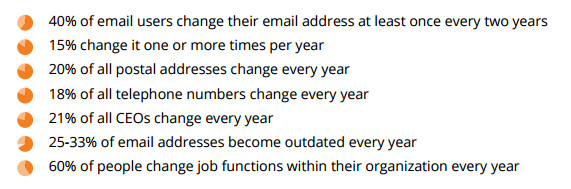
Information collected from prospects usually isn’t wrong when you’re first connecting with them. But over time, people move up (or move on) in companies, change email addresses, merge with other companies or segment their division into an entirely separate entity.

And it happens more often than we realize.

percentsIs Bad Data Really Worth Worrying About?

You may think that an incorrect email address or a wrong company contact here and there wouldn’t really make an impact – especially if you’re getting solid results from your existing campaigns. But for every lead that enters your funnel, there’s always the possibility that the information is changing quicker than your CRM database can keep up.

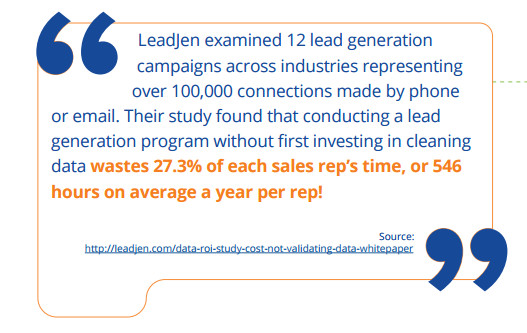
A study by DiscoverOrg found that sales and marketing departments lose approximately 550 hours and as much as $32,000 per sales rep from using bad data.

leadjen-sales

But putting a price tag on the number of sales lost from bad data isn’t just about the money. It’s about the time lost that could be better spent working on engaging leads rather than chasing down lukewarm non-responders. It’s about that burst in morale and spirit that comes from closing a sale when everything you do is right on target. It’s about maximizing efficiency and productivity on every level.

And at the heart of it all is the very data you’re collecting.

The Bad Data Snowball Effect

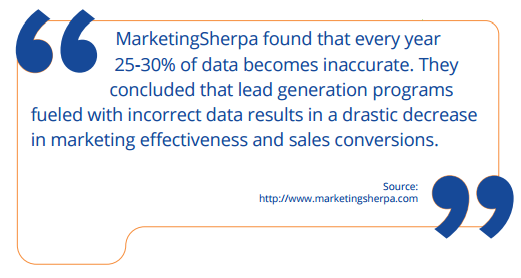
As more time passes, the effect of bad data seems to snowball. Not only is time wasted chasing incorrect or outdated data, but information (especially online) becomes outdated very quickly.

msherpa

The last thing you want is a database full of duds. But by the same token, incorrect or outdated information caused by the sheer vastness of data out there can also be improved by it – if you know where to look and how to keep your existing CRM data squeaky clean.

Getting Everyone On Board

The good news is, bad data doesn’t have to drag your conversion rate and closing numbers down. Now, more than ever, marketers are coordinating their efforts across multiple channels, which means the need for accurate data is one of their primary focuses.

That means that while the sales department likely has its own automation system for follow-up, marketing also needs to have its finger on the pulse of this information. Both parties should ideally be able to access, update and reference this information to form a complete, cohesive “big picture” of the data.

Even bringing customer or technical support into the fold is a smart idea. If service calls show that a certain problem is common but easy to fix, sales can break down that resistance early on, while marketing can pinpoint a way to introduce more customers to the solution based on its ease of use. All of these groups working in tandem helps create a more concentrated, goal-focused, customer-centered unit – and customers appreciate that kind of familiarity.

Practicing Good Data Hygiene

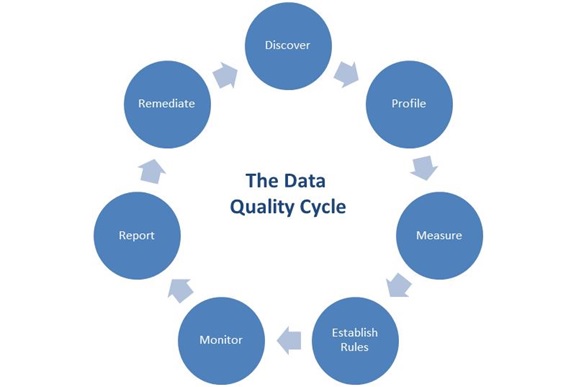
Inaccurate information can not only affect sales and productivity, but credibility as well. Good data hygiene means taking the time to clean up, verify and organize data so that common issues like duplicates, mismatches and missing elements no longer plague the system.

But in addition to scrubbing your CRM, it’s also a good idea to look beyond the details you’ve collected already. Can you connect social media usernames or accounts with these leads? What about mobile device information? If you’re just now opening the floodgates to sharing data between departments, are there any areas where information can be appended or merged so that you have a more complete picture of the customer?

Of course there is no shortage of both free and paid tools to help ensure optimal data cleanliness, many of which are already part of existing CRM software (like Salesforce) or other analytical tools. Oftentimes, companies will hire dedicated data-cleaning teams whose sole purpose is to keep records up to date and relatively error-free.

data-quality

Even the most accurate information will change over time

Even if you’re doing it yourself or with a small team, it’s easy to look at waves of bad data and feel like you’re drowning in inaccuracies. It’s no small task to not only correct bad data but keep it fresh and up to date. Creating a sort of “data plan” can help you eat that elephant one bite at a time. In creating such a plan, ask yourself the following questions:

  • Who has access to what information? Not only are there privacy and security policies to keep in mind, but also the fragmented nature of the data collection to begin with. Getting everyone on the same page and making sure the right people have access to the right information is crucial to making the most out of every campaign and strategy.
  • How do we measure data quality? – You already know fields like name, phone and email address have to be accurate, but how else can you measure data quality? Knowledgent has an insightful white-paper on the topic, including analyzing key points that can degrade the quality of the information you collect, like consistency, timeliness and uniqueness.
  • What path does our data take and how can we make it better? – Let’s say a customer in your database has just switched jobs. In addition to putting their new position in your CRM, consider things like whether or not they are still a key decision maker in their new role, and if not – who is. The last thing you want to do is compound the time lost by sales staff in chasing down referrals who don’t have the authority to move forward.
  • What goals can we set to make data cleansing more valuable? Turning bad data into good data is no small job. Taking it step by step by focusing on the high ROI targets will keep everyone engaged and motivated to improve. Set real, measurable, attainable goals and focus on the journey instead of the destination.

By putting these steps into practice, you’ll not only walk away with a squeaky-clean database, but improve your business credibility, resonate with your target audience, increase sales productivity and build stronger relationships with your customers at every stage in your lead generation funnel.

Have you been the victim of bad data? How has it affected your business? Which tools do you use to keep information current? Share your insights with us in the comments below.

About the Author: Sherice Jacob helps business owners improve website design and increase conversion rates through compelling copywriting, user-friendly design and smart analytics analysis. Learn more at iElectrify.com and download your free web copy tune-up and conversion checklist today!

Monday, January 18, 2016

How to Choose the Best Solar Panel Company

Solar energy is becoming increasingly popular due to its ability to produce electricity at home with no monthly fee. Strategically located on its property, a solar panel company will ensure that the panel absorbs sunlight and provides power 24 hours a day.

The production of energy from the solar panel can be translated into costs of your electricity bill. If your panel generates 75% of the required electricity, the monthly payment of its electricity will also be reduced.

In the long term, the solar panel will create added value to your home as an asset. If you decide to sell your home, your investment in a solar panel to pick a healthy return.

When looking for a residential solar contractor, look for someone who has extensive experience in the installation of a solar panel and make sure they are licensed and insured. It never hurts to ask if both are accredited by the BBB.

The longer someone has been in business, the more experience they have and other tips and tricks you know. It also tends to be a reflection of good business due to bad company do not stay for long! Probably also they experienced more problems than a person who has been in business for a short time in order to have the knowledge to help avoid these problems.

Feel free to ask questions or ask for references. A good contractor will be happy to provide you with everything you need and take the time to explain all the details and make sure you are comfortable. Learn about financing options and ask if you can show an estimate of energy savings over time. A reliable and qualified contractor offering residential solar financing options include lease with zero down so you can save money on electricity costs immediately.

There are state and federal incentives programs that can be tapped to help finance the cost of your solar panel. Ask what kind of incentives are available in your area, a competent contractor update this information.

Ask about warranties and learn about the best manufacturers – not all solar panels are created equal and are manufacturers. You want to make sure to protect your investment by using a top manufacturer and receives a guarantee not only of the panels, but also the installation and manufacturing.

The 8 Most Important Skills for Content Promotion (and How to Learn Them)

The bar has been raised.

Creating great content isn’t enough anymore if you want your content marketing to be successful.

Today, you need to not only create that content but also promote it.

image00

Many marketers have started to wake up to this fact, which is a good thing.

However, just because they recognize that promotion is important doesn’t mean they know how to do it effectively.

In my experience, only a small percentage of marketers possess the skills that make them effective promoters as well.

The big problem is that if you don’t have these skills, you'll struggle to learn how to promote effectively.

The reason for this is that there isn’t much help out there.

When it comes to creating great content, you can study the content your favorite blogs publish and attempt to replicate it.

But it’s next to impossible to understand all the work that goes on behind the scenes to promote that content unless the creators are generous enough to share it with you.

It takes a special kind of marketer—the cream of the crop—to learn both from resources (like blog posts) and experience.

These are the complete content marketers that get the results everyone else wants.

Honestly, I don’t know if you’re one of them—maybe not yet.

The good news is that you can become one of them if you’re willing to learn new skills.

In this post, I'll explain in detail the eight most important skills needed for effective content promotion.

If you recognize all these skills in your own work, you’re probably doing pretty well.

If you see you’re lacking a few of these skills, I’m going to show you exactly how to acquire and develop them.

Are you ready to put your skills to the test?

If so, let’s dive in. 

1. The best content marketers all have this skill…

This first skill might be the most important.

Critical thinking.

As a marketer who is still finding your way, you’ll be spending a lot of time learning about different tactics you can use to promote your content.

These might be email outreach tactics, link building tactics, or social media tactics…you get the picture.

But not all marketers who try a specific tactic will succeed with it. You probably know that already from firsthand experience.

It’s not because of luck or skill. Although these factors may play a role, the main factor that determines how successful you are with a tactic is fit.

Some tactics work in some niches and situations better than in others.

If you blindly try different tactics, you’ll have some success but not as much as you’d like.

The really good marketers, or the ones who seem to “get it” really quickly, are the ones who can critically think about a tactic.

They don’t just read a blog post and think, “This is pretty cool; I'd better try it!”

Instead, they think about questions like these:

  • Why does this tactic work?
  • What niches would it work best in? why?
  • Will this work for my content?
  • Can I can tweak it in any way to make it even more effective?
  • How can I test this?

Understanding a tactic before using it is different from just applying it blindly. I hope the reason behind those questions is clear.

Once you truly understand the tactics you learn, all of a sudden you are able to see where they fit together in an overall strategy.

The good news is that no one is born with critical thinking skills—these skills are developed.

And even better news is that you probably already have some, but maybe just need to consciously use them more often.

Regardless of where you are, let’s go through a complete example of how you would approach a tactic in real life.

Examining infographics with critical thinking: Here’s the situation: you come across an article I wrote about creating and promoting infographics.

image07

Of course, your first reaction is excitement when I explain how infographics can be used to get thousands of visits.

And they can, for sure. But not in all situations.

After you read the post, you want to ask yourself the same questions I listed above.

Q: Why does this tactic work?

Infographics work because they are attractive, easy to consume, and can convey complex information quickly.

On top of that, really good ones stand out and get extra attention.

Because infographics are so shareable, you’ll get a ton of traffic if you can get the initial views to them. Providing an embed code underneath the infographic makes it easy to share (and gets you extra links).

Q: What niches would it work best in? Why?

Infographics are an image-based type of content. Therefore, they probably work best in image dominated niches. Think clothing, design, food, and even marketing to a degree.

The most important factor mentioned was that the topic needs to be interesting, which means that viewers need to care about it.

In “boring” niches like heating or bug removal, which are not that interesting to people (in general), it’s going to be tough to get the infographic to spread.

Q: Can I tweak it in any way to make it even more effective?

The reason why the effectiveness of infographics seems to be declining is that they’re becoming more commonplace.

So, if I can come up with a way to make mine more unique, I should be able to get better results. Perhaps, I can make a gifographic instead.

Q: How can I test this?

To test this tactic fairly, I would need to produce at least 5-10 professionally designed infographics.

This means I’ll likely need a budget of around $2,000-4,000.

I will then determine its effectiveness by looking at a few key metrics:

  • cost per subscriber
  • cost per link
  • cost per visit

Then, I will compare those metrics to the metrics of other tactics I've used to determine if I should produce more infographics.

End questions. In reality, you’d probably want to ask yourself even more questions.

How many readers of this blog or any other marketing blog honestly do this after reading about a tactic?

While I have some of the most active readers I’ve ever seen, which is great, I would guess far fewer than half of the readers who read a post do this.

If you want to develop critical thinking skills, you simply need to practice thinking. Ask yourself hard questions and try to get the best answers you can.

It’s okay if they’re not perfect; you’ll get better over time.

2. How far can you dig?

One question that I get all the time is: “How long does it take you to write your posts?”

Truthfully, it doesn’t take that long. Typically, I can do the actual writing in about 3 hours plus some time for editing.

But creating a post takes longer than that. It also takes a lot of research. Some posts, of course, will require more research than others.

Research is one of the most undervalued skills in a content marketer. Research is definitely important when it comes to creating content, but it is probably even more important when it comes to content promotion.

A lot of modern day promotion is based on email outreach, and it’s important you understand some basic numbers.

Most effective tactics will have a conversion rate of 5-10%. That means that for every 100 emails you send, 5 to 10 will end up in links. The actual percentage will depend on a lot of factors, e.g., your niche, copywriting skills, and quality of content.

Keep in mind that the conversion rate I quoted above is for the best tactics. Most tactics will have a lower conversion rate.

What does this mean in terms of research?

It means that you’ll have to send a ton of emails as part of your promotional campaigns. You’ll want to get at least 20-30 links to the content you've spent a few hundred dollars on creating.

In most cases, that means you’re sending 400+ emails, sometimes thousands.

Over time, that number won't seem that big, but at first, I understand why that would seem like a ton.

In reality, there are two big components to this:

  • sending the actual emails and
  • researching hundreds or thousands of good prospects

The research usually takes more time than sending the emails, at least until you establish key relationships in your niche.

Since you’re dealing with hundreds or thousands of data points, it’s crucial that you work efficiently.

This usually means working with tools and knowing how to use them effectively.

For example, you could manually search for resource pages to target for a link. You could probably create a list of 100 in an hour or so.

Or you could simply find a similar type of content, plug it in a tool such as Ahrefs or Majestic, and have a list of hundreds or thousands of targets in seconds.

image08

Work smarter, not harder (when possible).

3. Are you able to determine what is and isn’t important?

By now, you understand pretty well what promoting consists of.

And to be honest, it’s an insane amount of work.

You could easily hire someone (or multiple marketers) just to do promotion for your content.

In most cases, you can’t do that.

Instead, you need to find a way to balance content creation with content promotion while running other parts of your business as well.

Introducing the 80/20 rule: The skill I’m focusing on in this section is your ability to identify which of your actions produce the most results.

There’s a fairly established rule called the 80/20 rule (or Pareto principle).

image06

It states that 80% of your results come from 20% of your effort. And it applies to just about everything.

One of the things it applies to is content promotion:

  • 80% of your traffic will come from 20% of the links
  • 80% of your links and traffic will come from 20% of your promotion tactics

In almost all cases, if a sample size is large enough, these numbers will be fairly accurate. They may differ by 5-10% in each direction, but the effect remains the same.

Using the 80/20 rule to eliminate fluff: The reason why I showed you this rule is because it’s possibly the most effective way to save a lot of time without losing much in the way of results.

In fact, you can often get better results in less time once you understand how the rule works in your case.

By breaking down your efforts and results, you can determine which of your efforts are contributing the most to your results.

Then, you can cut out all the rest. Why spend 80% of your efforts on only 20% of the returns you want?

Instead, use that extra time you freed up to double or triple down on that 20% of activity that actually produces results.

Here’s what it might look like in practice…

Track all your efforts and results, then eliminate waste: You never want to guess what is and isn’t effective.

Instead, start by tracking what you do to promote content, how much time you spend on it, and what you get in return for that effort.

Tracking time is pretty straightforward, but you’ll have to track your other metrics using tools such as Google Analytics (for traffic) and Ahrefs (for links).

Here are some hypothetical results:

image05

The traffic per hour value is calculated by dividing the traffic from that activity by the time spent on the activity.

I used traffic as the main goal for this promotional campaign, but yours could be links, social shares, or whatever else you’re looking for.

Finally, you can calculate the percentage of results value by dividing the traffic per hour value by the total “traffic per hour” amount (e.g., 300/1466 for email outreach). This is a fair comparison since they are all based on a “per hour” basis.

What we see is that almost all of the results come from email outreach and emailing subscribers (about 88%). Those two activities take up 5.5 out of 11.5 hours of effort, or a little under 50% of the total effort.

This also illustrates that it doesn’t matter if there’s a perfect 80/20 ratio. You just want to see which activities are producing the least from your efforts.

In this case, you could cut out over half of your effort and lose only about 12% of the results, a great trade off.

Even if this time was spent just on more email outreach, you could take your total traffic from 2,500 to about 3,500 (a 40% increase).

If you wanted to spend more time emailing your subscribers, you could do it indirectly by spending the extra time trying to get more subscribers. This could be done by creating lead magnets or by employing other tactics to try to improve your conversion rate.

The bottom line is that you need to be efficient.

Find any effort that isn’t producing results (like screwing around on social media), and cut it out. You don’t have time to waste if you want to be a good content promoter.

4. Social skills on the Internet?

Marketers come from all sorts of backgrounds.

A large portion of the new generation of Internet marketers was attracted to the profession because it offered a chance to make money without truly interacting with people.

Or at least that’s what they thought.

If you want to be a legitimate and successful marketer, you need to have at least basic social skills.

You need to know how to communicate with co-workers, influencers, and your readers in a way that doesn’t seem awkward or manipulative.

This comes down to basic human interaction, especially in emails.

A lot of promotional success comes down to building relationships with people, and if you can’t hold a conversation, in any medium, it’s going to be tough to succeed.

Most people have these basic social skills, but if you think yours can be improved, read Ramit Sethi's The Ultimate Guide to Social Skills, which is by far the most useful guide on the subject I’ve come across.

5. The ability to care about others will take you far

It’s a harsh truth.

No other website owner truly cares about your content.

So, when you email them asking them to take a look at it and give you a link of some sort, it’s tough to get a positive response.

That’s why good marketers never just ask for things.

Instead, they provide value upfront.

They do something nice for an influencer, and most people return the favor. It’s called the rule of reciprocity.

image04

That’s a very simple concept that every marketer should know.

What really sets good marketers apart, however, is empathy.

Empathy just means that you’re good at viewing things from the perspective of others and understanding how they feel.

It’s an important skill in all parts of marketing, but especially promotion.

It’s another one of those skills that help you understand when certain tactics should be used.

For example, consider broken link building.

The idea is that you find broken links on someone’s website and then you let them know about the broken links and suggest yours as a replacement.

It’s a completely valid tactic in some cases…

Empathy allows you to understand what people care about.

The guy managing a resource page in your niche? He probably cares about keeping the page as up-to-date and useful as possible.

Why? Because the whole page is dedicated to links that help the visitor. If those links are dead, it has a big impact on the usefulness of the page.

Here’s an example of what one might look like.

image01

What about the guy running a small blog? He also probably cares about broken links.

What about me? If someone emailed me telling me that I have broken links on Quick Sprout, how much would I care?

To be honest, not very much. I have hundreds of articles on Quick Sprout, so it's inevitable that I'll have a few dead links here and there.

I realize that dead links aren’t good for readers, but it’s honestly a small concern compared to all the other work I currently have to do for the site (and my other sites).

So, when people email me about dead links (they do quite often), they are not going to get my attention.

They’ve failed to understand the value I place on the broken links.

The reciprocity principle can work on just about anyone, but first, you need to give the other person something they value.

Can you develop empathy? I’m of the opinion that you can develop empathy just like any other skill.

However, it’s probably the most difficult skill to teach because I can't just give you a guide or offer a course on it.

Instead, the only way to get better at it is to consciously put yourself in someone else’s shoes as often as you can.

Try to guess what they care about, and if possible, confirm it by having a conversation with them.

My best advice would be to pick five people you know every day, and answer questions like these for all of them:

  • “What are the things I value most in my life?”
  • “How much do I care about my professional life?”
  • “How often do I try to do something nice just to try to be a good person?”
  • “How loyal am I to my friends?”

You’ll probably have to do a little bit of Internet snooping for each person to answer these questions. Hopefully, you’ll begin to notice that you start thinking from another person's perspective automatically when you’re trying to contact someone to promote your content.

6. A sloppy marketer is an unproductive one

Even though this article isn’t directly about promotion strategies and tactics, you’ve still gotten a good glimpse at what effective promotion looks like.

One of those things was the scale that you need to achieve.

A single piece of content may often have an entire campaign created around it, consisting of hundreds or thousands of emails.

Mix in a few different tactics, and there is a ton of data you need to keep track of.

This skill is a basic one: organization.

If someone asks you why they should hire you, they won't be impressed if you tell them you have amazing organization skills. That’s because it’s expected.

If you can’t keep track of what you’ve done and what you have to do, there’s no way you’ll be able to run an efficient promotional campaign.

I’ve gone into it in great detail in the past, but for now, understand that there are three main components to organization as a marketer:

  1. Attitude - You need to want to be as productive as possible for yourself, your boss (if you have one), and your readers. This means you understand the importance of organization and put in the effort required.
  2. Technology - I write a lot about different tools you can use to be a more effective marketer. There’s a reason for this. Tools are a key part of working efficiently and staying organized. Even basic tools such as Google Docs and Trello go a long way when it comes to keeping track of things.

image033. Adapting - Staying organized is a commitment. You need to commit to staying up-to-date with relevant tools. You have to commit to keeping track of all your work, even on days when you feel a bit lazy. When something new is added to the promotional campaign, you need to find a way to fit it into your organizational structure.

When you have thousands of emails to send and keep track of, you need to have an organizational system in place.

I realize it’s not fun, but it ensures that you reach all your targets and that you don’t do anything stupid like email the same person twice asking for links.

7. Will your content promotion be effective in the future?

A sign of a good content marketer isn’t how much they know.

That's because in a field such as marketing, knowledge goes stale quickly.

What worked even a few years ago doesn’t work now.

What’s more important is that you are continuously learning.

One part of that is reading other marketers' blogs. Since you’re here, I’m guessing you have that covered.

Even just reading one post a day adds up quickly.

I suggest using a tool such as Feedly so that you don’t waste time monitoring when posts come out (or just become an email subscriber of your favorite blogs).

image02

A good portion of marketers do that first part.

What they don’t do is experiment.

Marketing may not be a field of science, but you constantly need to test different tactics and strategies.

You need to be able to quantify what does and what does not work effectively.

For the most part, this involves split-testing.

For example, you might want to determine the effectiveness of sending an initial email to someone without asking for a link in that first email.

To do this, you would send some emails that did ask for a link right away and some that didn’t.

Then, once you had a valid sample size, you could compare the results.

From there, you could continue to test different approaches.

It’s crucial to test on a regular basis because all tactics will become less effective over time. It’s up to you to try to find more effective tactics before they become “ruined” by all the other marketers out there.

If you’re new to testing, it can seem intimidating, but it gets simple once you know what to do. Here are some guides to testing that will walk you through the entire process:

8. Can you lead AND follow?

Content promotion campaigns can take many different forms.

One component that often changes is the role you have to take.

Sometimes, you’ll do all the work yourself. That’s pretty straightforward—you just do things the way you like.

But you might be part of a marketing team and will likely need to follow instructions.

Even more common, you might find yourself having to lead. I say it's more common because even if you do all your marketing yourself, you can start hiring freelancers to help you with certain parts of promotion.

Or you might want to hire content creators so that you can spend more time on promotion.

Here are a few good guides on managing help effectively:

Conclusion

Don’t get me wrong, content creation is incredibly important.

However, as far as the overall content marketing effectiveness goes, content promotion is often more important.

Furthermore, there’s a smaller percentage of marketers who know how to effectively promote content, so it really separates them from the rest.

If you want to be the best content promoter you can be, you need to develop all of the skills I went over in this article.

Take a minute to honestly assess your skill level in each area. Then, come up with a plan to improve it, but focus on your biggest weaknesses first.

If you’d like to share your results or you have any questions about the skills, I’d love to hear from you in a comment below.